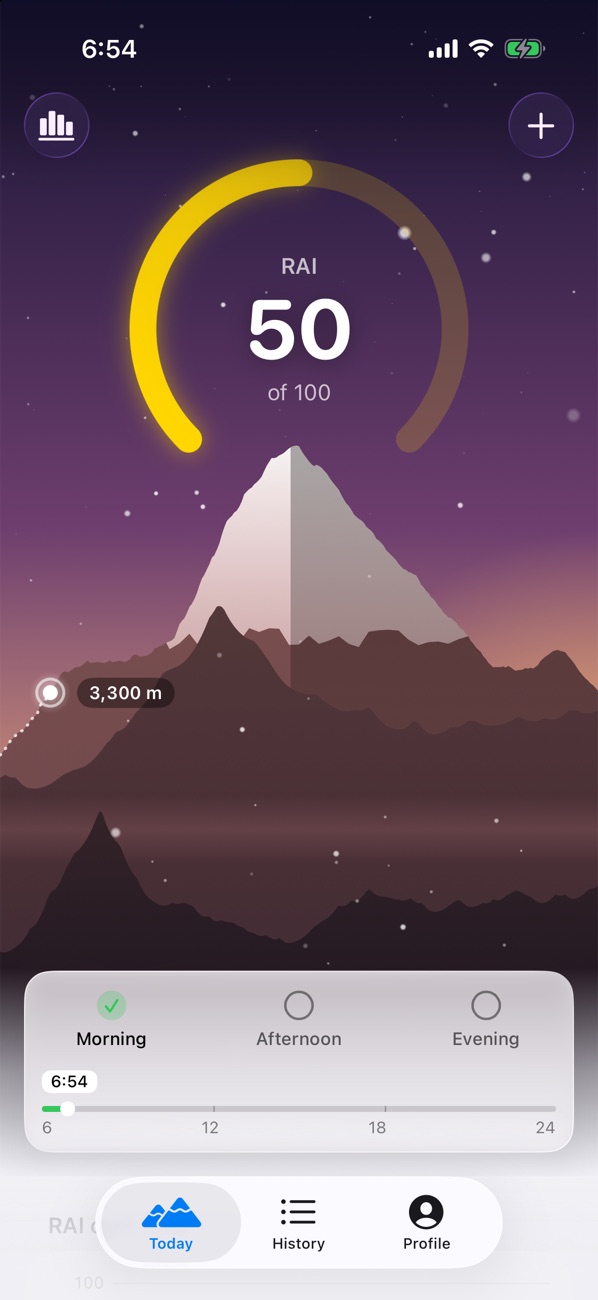
Rarefa compares your SpO₂, heart rate and altitude with your own baseline, so you see how your body is responding to the climb.

The RAI (Rarefa Altitude Index) looks at how far your readings have moved from your usual values, along with how fast you climbed and where you slept. Higher means your body is coping better.
Your usual SpO₂, resting heart rate and home altitude, imported from Health or entered in Profile.
Log a check a few times a day, even when you feel fine. Readings come from Health, altitude from GPS.
Tap the score to see what lowers it: SpO₂ drop, heart rate rise, pressure, ascent rate and sleeping altitude.
Log sleep duration, average SpO₂ and T90. Sleeping much higher each night above 3000 m lowers the score.
Guides see the SpO₂, heart rate, altitude and score of nearby participants over Bluetooth.
Your coordinates, full screen and large enough to read out to rescuers.
Every check and night, with charts of RAI, altitude and SpO₂ over time.
Everything is saved on the phone right away and syncs when there's a connection. Sign in with an email code, no password.
Export everything as CSV whenever you want, or delete it.
The RAI is an experimental score compared to your own baseline. It isn't a risk of altitude sickness or clearance to climb. With significant symptoms, stop climbing and follow medical advice.